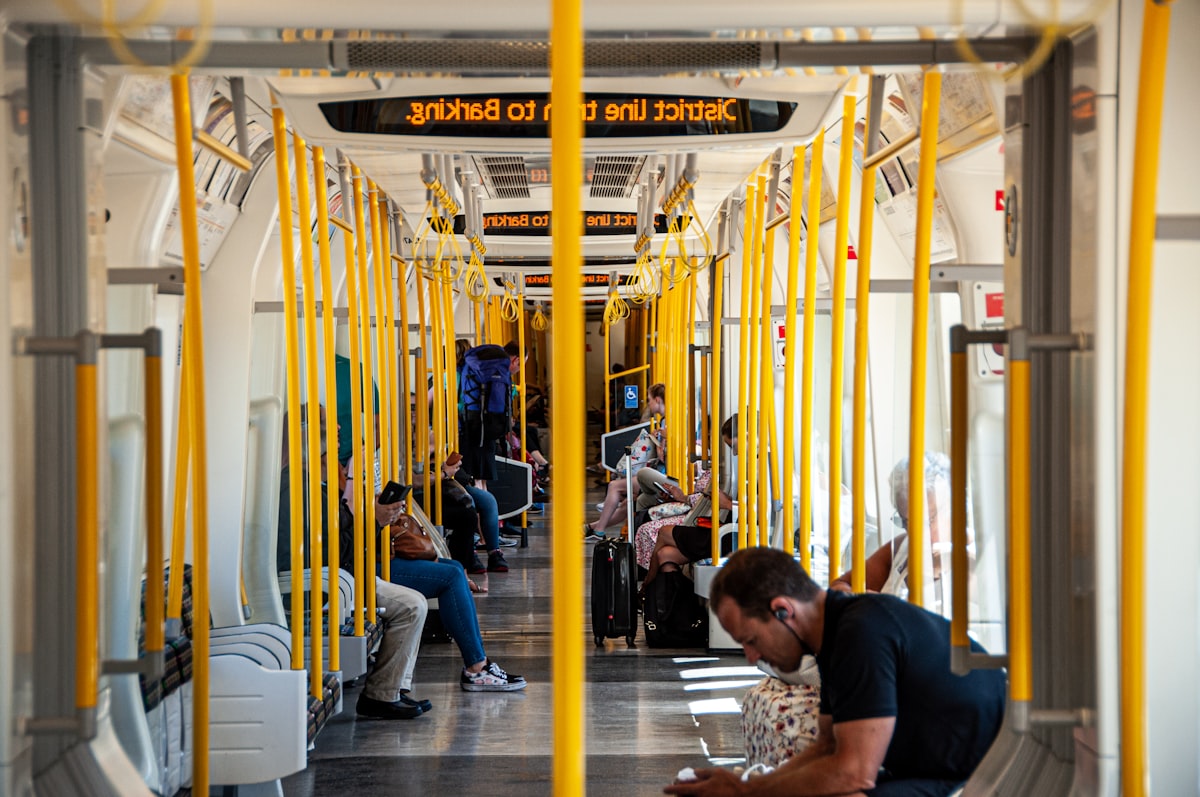
What follows is a long-form, slightly nerdy, data-forward look at London Underground heat: how hot it actually gets (with the best public datasets), why the heat accumulates, what London has tried - including some ideas best left in the “well, at least you had a go” folder - how other cities handle it, what passengers actually say, and what is plausibly coming next.
How hot is “hot”, exactly?
The most useful public numbers are TfL’s platform temperature monitoring for the deep-level lines, published as average monthly temperatures at evening peak. These are not carriage temperatures, and they are not a single “hottest moment”. They are better than anecdotes because they are consistent, network-wide, and tracked over time.
Using the London Datastore dataset (2013-2024), the Victoria line is the outlier in two ways: it is the hottest on average and it has shifted upwards dramatically over the last decade.
| Line (evening peak platforms) | 2013 avg (°C) | 2024 avg (°C) | Change |
|---|---|---|---|
| Victoria | 21.9 | 28.2 | +6.3°C |
| Central | 25.0 | 26.8 | +1.8°C |
| Bakerloo | 25.5 | 26.4 | +0.9°C |
| Northern | 22.7 | 25.3 | +2.7°C |
| Piccadilly | 22.8 | 23.6 | +0.8°C |
| Jubilee | 21.5 | 22.0 | +0.6°C |
| Waterloo & City | 20.7 | 20.6 | −0.1°C |
| Sub-surface lines (avg) | 17.9 | 19.1 | +1.3°C |
In 2013, Victoria line platforms ranged from roughly 18-27°C across the year. In 2024, they ranged from roughly 26-31°C. The “cool month” is now warmer than the “hot month” used to be.
In 2024, August was the peak month across every line in that table, with Victoria around 31°C and Central around 30.6°C. Carriages can feel worse than platforms because you add passenger body heat, constrained airflow, and heat released by the train itself. That is why, on a busy deep-level service, the lived experience can be “platform is unpleasant, carriage is a mistake”.
The hot season is no longer just summer
The more revealing metric is not the hottest month, but how long the heat lasts. In 2024, Victoria line platforms averaged more than 28°C during the evening peak for six consecutive months, from May through October. Central managed four months above 28°C, Bakerloo three, and Northern one. The sub-surface lines never crossed 28°C at all.
| Line | Months above 28°C in 2024 | Months above 30°C in 2024 | 2024 peak |
|---|---|---|---|
| Victoria | 6 (May to October) | 3 (July to September) | 31.1°C |
| Central | 4 (June to September) | 1 (August) | 30.6°C |
| Bakerloo | 3 (July to September) | 0 | 29.9°C |
| Northern | 1 (August) | 0 | 28.8°C |
| Piccadilly | 0 | 0 | 27.4°C |
| Jubilee | 0 | 0 | 26.2°C |
| Waterloo & City | 0 | 0 | 24.1°C |
| Sub-surface lines | 0 | 0 | 25.7°C |
The sharpest comparison is January versus August. Victoria line platforms averaged 25.7°C in January 2024. The sub-surface lines peaked at 25.7°C in August. In other words, the Victoria line’s winter baseline is now roughly equal to the hottest month on the more ventilated, partly air-conditioned sub-surface network.
Measurement caveat (important, but not a get-out-of-jail-free card)
TfL’s published figures are platform measurements at specified times and locations. Carriage temperatures and humidity vary more sharply with crowding and train design. If you are thinking, “I have definitely been hotter than that”, you probably have. The dataset does not claim to capture the maximum misery. The point is trend and comparison: which lines run hotter, and whether the baseline is drifting upwards.
The physics of a hot railway in a tight tunnel
There are two parts to the Tube heat story: heat generation (where the energy comes from) and heat rejection (how, or whether, that energy escapes). London’s deep-level lines are strong on the first and weak on the second.
Where the heat comes from
A widely cited breakdown from London Underground engineering work (via CIBSE reporting) puts the heat sources roughly like this:
A Tube train pulling into a station can release on the order of ~350 kW of heat during braking. If you are not used to kW: that is “many homes worth of heat”, briefly, repeatedly, all day. If you built a railway specifically to turn electricity into heat, you would struggle to beat “stop every 90 seconds, in a narrow pipe”.
Modern traction systems can feed some braking energy back into the electrical system. London Underground uses regenerative braking, but it only recovers energy when the network can accept it - for instance, another train nearby drawing power. The remainder still becomes heat. So regenerative braking is a genuine mitigation, but not a full solution. (We cover braking distances and how fast the Tube actually goes in a separate piece - short version: the constant stopping and starting is a bigger factor than top speed.)
Passengers: small share of total heat, large share of perceived suffering
The “~2% passengers” figure is about heat added to the tunnel system overall. It can still dominate how the carriage feels. A resting adult sheds roughly 70-120 W as heat. Put 800 people into a train and you have something like 60-100 kW of warm bodies, right where you do not want it. Even if that is modest compared with braking energy across the system, it matters locally - and it is one reason “same platform temperature” can feel radically different at 08:25 and 11:10.
London Clay was a great heat sink, until it wasn’t
Early in the deep-tube era, tunnel temperatures were close to the surrounding ground temperature, often cited around 14°C. London Underground even marketed this in the 1920s with an “It’s cooler below” poster.
The original “design” (in quotes, because it was not designed as a thermal system, it just behaved like one) was: heat produced by trains, absorbed into tunnel lining and surrounding clay, gradually dissipated into the ground. This worked when service levels were lower and the ground was effectively an infinite sink. Over decades, the ground around the tunnels warms. Once the clay has absorbed a great deal of heat, it becomes less of a sink and more of a storage heater that someone accidentally left on.
Ventilation is constrained by geometry, history, and competing priorities. Deep-level tube tunnels are narrow. Vent shafts are limited by what is on the surface, and by what you can physically dig through a dense city. More airflow can help thermal comfort, but it must be balanced with smoke control, dust movement, noise, energy costs, and the “piston effect” - moving trains push air around in ways that can fight your intended airflow. In other words, “just add fans” is not stupid, but it can be disappointingly non-linear.

Deep-level platforms trap heat from braking, motors, and hundreds of bodies - with nowhere for it to go. Photo via Pexels.
A short history of “cooling the Tube”
Why London can’t just do what everyone assumes is obvious
When people say, “Why not air condition the trains?”, they are not being obtuse. Many cities do exactly that. The problem is that air conditioning is not “coldness”; it is heat moved from inside the carriage to somewhere else.
On deep lines, “somewhere else” is usually the tunnel air, unless you have a clever way to reject heat outside. If you cool the carriage by dumping heat into the tunnel, you can make the wider environment worse unless you also improve heat extraction.
There are also pure geometry issues. Roof-mounted AC units - common on modern trains - clash with the Tube’s tight loading gauge. Underfloor AC is possible, but it demands space, maintenance access, and compatible airflow paths. More power draw for AC means higher electrical load, and ultimately more heat somewhere in the system unless efficiency gains offset it. None of this means “impossible”. It means “expensive, slow, and entangled”.
How London compares internationally
A useful way to compare metros is by asking three questions: Are stations enclosed and air-conditioned, or naturally ventilated? Do trains have AC, and how is heat rejected? How old and constrained is the infrastructure?
Singapore & Dubai
Newer systems in hot climates that treat the metro as an indoor environment. Platform screen doors keep cool air in. Designed for HVAC from day one.
Hong Kong & Seoul
Enclosed, highly managed environments with station air-conditioning and platform doors in many locations. Both for safety and thermal control.
New York
Old, heavily used, and famously uncomfortable. But roughly 99% of subway cars have functioning AC. Stations can still be brutal - a useful cautionary tale for “carriage AC ≠ system cooling”.
Paris
A close analogue: old metro, mixed depths, constrained tunnels, lots of passengers. RATP has relied on ventilation rather than full train AC, with long rolling stock renewal timelines. Sound familiar?
London cannot replicate the newer systems quickly because it would require extensive retrofits: platform doors, reworked ventilation, and new train environmental systems, all constrained by heritage geometry. And when Londoners say “but Paris manages”, the honest answer is: Paris manages some of it, some of the time, and often via long, expensive renewal cycles, much like London is now trying to do.
The ideas London has tried (and the ones that keep coming back)
It is tempting to frame Tube cooling as a single missing invention. In reality, London has cycled through a fairly standard menu of thermal-engineering options, each constrained by underground reality.
A Move more air
Improve fan reliability, increase ventilation capacity, make better use of shafts and draught relief. It delivers incremental gains and helps avoid the worst peaks, but it struggles to reverse a high baseline when the ground is already warm.
B Cool stations locally
Platform-level cooling at major interchanges like Oxford Circus and Green Park. Fan-chiller systems at St Paul’s, and at a ventilation shaft between Walthamstow Central and Blackhorse Road. The Holborn cooling panel trial - a newer, lower-maintenance flavour of the same general goal. This approach is pragmatic. It does not “solve the Tube”, but it can protect the hottest pinch points.
Oxford Circus is also a useful cautionary tale. TfL did not simply ignore the problem there: in 2012, it installed platform-level air cooling units across the Bakerloo, Central, and Victoria line platforms, supplied by chiller units on a TfL-owned building above the station. But London Centric reported in 2026 that the cooling element failed in 2017 and has effectively been decommissioned since, with the remaining units only circulating air and providing ventilation. That makes Oxford Circus a neat summary of the wider Tube cooling problem: London can build targeted fixes, but keeping them working, funded, and worthwhile against other network priorities is another challenge entirely.
C Use water as your heat transport
Water-based schemes are attractive because they can move heat efficiently through small pipes. They also fit London’s reality: water already needs to be pumped out of tunnels (tens of millions of litres per day), and boreholes can access cooler temperatures at depth. This is why groundwater-based air handling appears repeatedly in engineering literature and TfL deployments.
D Recover waste heat
A genuinely modern twist: treat Tube heat as a resource. Heat recovery projects capture warm air at ventilation shafts, upgrade it with heat pumps, and feed local heat networks. Academic and applied work suggests the waste-heat resource is substantial - hundreds of GWh per year are often cited. This does not automatically cool the whole network, but it can reduce local tunnel temperatures around extraction points, and it improves the economics by turning “cooling” into “cooling plus revenue or carbon savings”.
E New rolling stock with cooling designed in
This is where the story finally gets more optimistic, because London now has something it has not had before: a deep-level train designed with AC as an explicit requirement.
On 20 June 2025, TfL confirmed the new Piccadilly line trains would enter service in the second half of 2026. They will be the first deep-tube trains to have air conditioning, enabled by space-saving design and under-train placement. TfL claims they will also consume around 20% less energy than existing designs.
But the new trains will not be trying to turn the carriage into a fridge. According to TfL’s 2025 FOI response, the system uses vapour-compression refrigeration with a saloon target temperature that varies with ambient conditions: around 19°C when it’s 10°C outside, 22°C at 20°C ambient, and 26°C at 30°C ambient. That is still a major improvement for a deep-level line, but it also explains why the next generation of Tube cooling is likely to feel “comfortable enough” rather than cold.
If you are interested in the broader story of how the Piccadilly line fits into Underground modernisation, we covered it in detail in our piece on when the Tube will be fully automated.
What passengers actually say
If you strip away the engineering, the public conversation is remarkably consistent across years and platforms (pun intended).
The complaint data backs up the platform numbers
TfL’s own complaint records line up with the temperature dataset. A 2025 Freedom of Information response shows that in 2023, TfL logged 49 London Underground complaints categorised “Temperature - Too hot”. Thirty of those, around 61%, were for the Victoria line - more than every other line combined.
In the first half of 2024 the picture broadened: 15 “too hot” complaints in total, with Victoria and Central both on four, Northern on three, Bakerloo on two, and Jubilee and Metropolitan on one each. That fits the temperature data: Victoria is the persistent outlier, while Central becomes especially uncomfortable as the weather warms.
Londoners: dark humour, tactical routing, resigned competence
In London-focused forums and threads, you see the same motifs. The Central line and Victoria line are described as “saunas”, “ovens”, or “free hot yoga”. People develop route heuristics: take the bus if it is not raining, swap deep lines for sub-surface where possible, and avoid peak crush if you have any flexibility.
Visitors often fixate on the mismatch between London’s mild surface climate and the Underground’s persistent warmth. People from cities where metro systems are fully air-conditioned describe London’s deep lines as unexpectedly harsh, because they mentally file “cool metro” under “basic urban infrastructure”.
Conversely, people from cities with hot, old metros - New York is the obvious example - tend to say some variant of: “yes, it is bad, but at least your stations are not also leaking, screaming, and 100 years overdue a fan belt”. Which is both a compliment and not a compliment.
The one genuinely funny constant: everyone believes their line is uniquely cursed. Even with data showing Victoria and Central as consistent leaders, every line has its devotees insisting that their commute is the true circle of hell. Heat is the great unifier.
So what happens next?
Piccadilly trains & station cooling
New air-conditioned Piccadilly line trains from H2 2026. Potential deployment of cooling panels at named Piccadilly stations. Rollout is gradual - a new fleet enters service over time.
The deep-tube renewal question
Broader deep-tube fleet replacement depends on sustained capital investment. Once you accept that deep-level AC largely requires new trains, the whole debate becomes a funding story as much as an engineering one.
Climate change & baseline drift
Heatwaves are becoming more frequent and intense. Research links higher temperatures to fault exposure and operational challenges. Doing nothing is not neutral - it is a choice to accept rising discomfort and operational risk.
The most realistic “future mix” is a portfolio: air-conditioned deep-level trains introduced line-by-line as fleets are renewed, selective platform and station cooling at the worst hot spots, ventilation upgrades where feasible, waste heat recovery where there is nearby demand, and operational measures during extreme heat. It is not as satisfying as “one big project fixes everything”. It is, unfortunately, more like how large, old, urban systems actually get better.
Practical advice that is not just “be less warm”
- Prefer the sub-surface lines (Circle, District, Hammersmith & City, Metropolitan) for the air-conditioned S-stock trains and more ventilated infrastructure.
- Treat Victoria and Central as the high-risk options in summer, because the platform data consistently flags them as hottest. Check the live line status before travelling.
- Carry water. It is banal advice, but TfL repeatedly pushes it during hot weather for a reason.
- Consider alternatives when it is really bad. A Lime bike or bus for a short hop can be cooler and faster door-to-door than a deep-line journey with a change.
- Travel off-peak if you can. Fewer riders means lower body heat and less crowding - the carriage at 11:10 is materially more comfortable than the same carriage at 08:25.
- Victoria line is the outlier: 28.2°C annual average in 2024, up from 21.9°C in 2013. The “cool month” now exceeds the old “hot month”.
- Braking generates ~50% of tunnel heat: Trains stopping every 90 seconds in narrow tubes is, thermally, close to the worst-case design.
- London Clay is no longer absorbing heat - it is radiating it back: The original “infinite heat sink” is saturated around the hottest tunnels.
- “Just add AC” is a systems problem, not a shopping trip: Carriage cooling dumps heat into the tunnel. Without extraction, it can make things worse.
- New Piccadilly line trains (H2 2026) will be the first deep-tube AC: A genuine milestone, but fleet renewal takes years and capital.
- The realistic path is a portfolio: New trains, targeted station cooling, better ventilation, waste heat recovery, and operational measures during extremes.
- London Underground average monthly temperatures dataset (2013-2024) - London Datastore
- Piccadilly line trains to begin operating in 2026 - TfL press release, 20 June 2025
- TfL trials innovative cooling solution - TfL press release, 22 July 2022
- London’s tunnel vision - CIBSE Journal (heat sources, braking heat, ventilation fractions)
- Greenham et al. (2023) - The impact of heat on London Underground infrastructure - Weather (RMetS)
- Ampofo et al. (2004) - Applied Thermal Engineering
- Sadokierski (2007) - Heat Transfer in Underground Rail Tunnels - arXiv
- Lagoeiro et al. (2022) - Building Services Engineering Research and Technology (SAGE)
- 99% of subway cars have functioning AC - MTA press release
- Air conditioning on Paris Metro - RATP
We build highly customisable tube alerts for the London Underground, Overground, DLR and Elizabeth line. Choose your lines, set your time window, pick your days, and filter by severity. We will only email you when something actually affects your commute.
Set up a free alert →
When Will the Tube Be Fully Automated?
Driverless trains, Grades of Automation, platform edge doors, and what TfL documents actually say.
Is the Tube 24 Hours? Night Tube Guide
Which lines run all night, when they operate, and your alternatives when the Tube shuts.
How Deep Is the Tube?
Depth data for every station, the deepest platforms, and why depth matters for ventilation and heat.
This article is regularly updated as new data becomes available. Send us a tip if you spot something we should include.