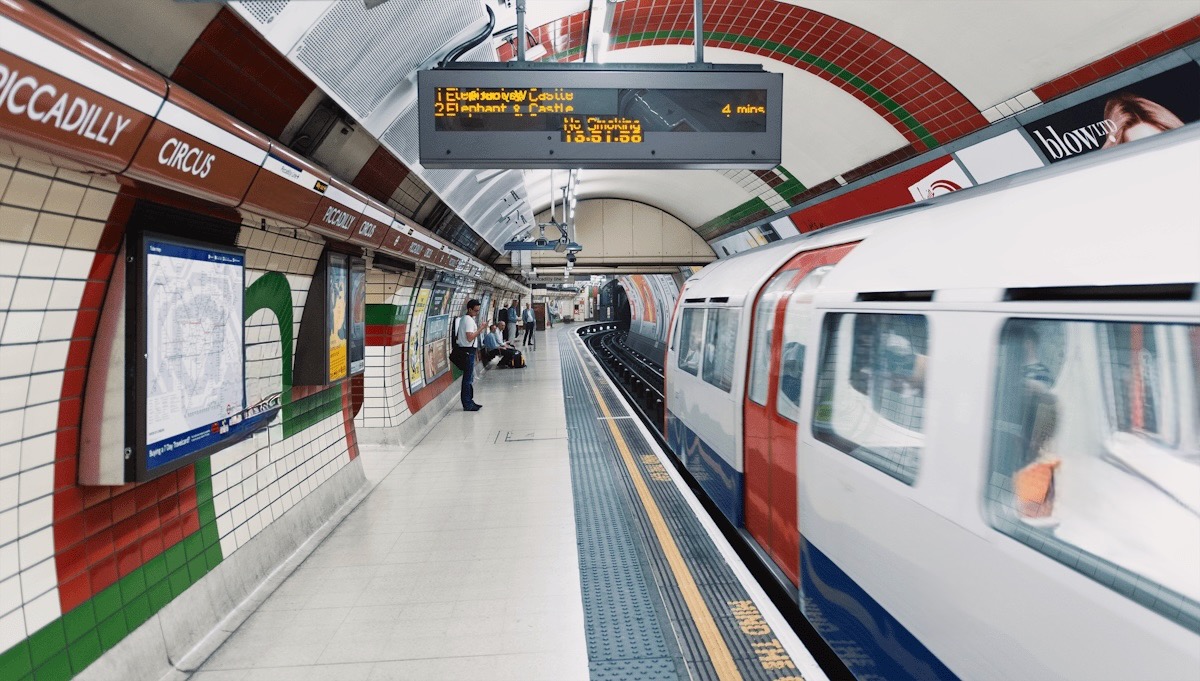
London already runs much of the time with the computer doing the driving. What it does not have is the kind of system where a train can run in passenger service with no staff on board, and no one in a cab to intervene.
So, when will the Tube be fully automated?
If "fully automated" means unattended operation (no driver, no on-board attendant), the most evidence-led answer today is: there is no active plan, and recent official work concluded it would be prohibitively expensive to pursue across the network.
That does not mean automation is standing still. It means London's path is more likely to be "more GoA2 in more places" (computers driving under supervision) than a leap to a fully driverless Tube.
First, what "automation" actually means
Railways tend to talk about Grades of Automation (GoA), a standardised set of definitions used internationally. Transport for London summarised these grades in an FOI response, citing the IEC standard.
- GoA0: Line-of-sight operation (typical for trams in mixed traffic).
- GoA1: Non-automated train operation (driver controls movement, with protection systems).
- GoA2: Semi-automated operation (ATO drives; a driver remains for doors, supervision, and emergencies).
- GoA3: Driverless train operation (no driver, but an on-board attendant handles doors and incidents).
- GoA4: Unattended train operation (no staff on board).
Those definitions matter because London sits largely in GoA2 territory on several lines already. The computer accelerates, brakes, and hits station stopping points. The human role is not "steering" in the everyday sense, but dispatch, passenger safety, and managing the weird stuff.
Where London is today, line by line
Here is TfL's own snapshot of "current mode of operation" for key lines and systems.
| Line or system | TfL-stated current mode |
|---|---|
| Waterloo & City | GoA1 |
| Central | GoA2 |
| Bakerloo | GoA1 |
| Victoria | GoA2 |
| Piccadilly | GoA1 |
| Sub-surface railway (Circle, District, H&C, Metropolitan) | GoA2* |
| Northern | GoA2 |
| Jubilee | GoA2 |
| Elizabeth line | GoA2 (core) |
| Docklands Light Railway | GoA3 |
*TfL notes that the sub-surface railway is currently GoA2 across the Circle line and on specific sections of the other sub-surface lines, reflecting where the newer signalling is in place.
Two details in that table are easy to miss, but important:
The Elizabeth line core is GoA2, and TfL notes GoA3-style auto-reversing is available for non-passenger moves in a short section (Paddington to Westbourne Park).
The DLR is GoA3, which is often what the public means by "driverless": no driver in a cab, but a member of staff on board to manage doors, evacuation, and degraded operation.
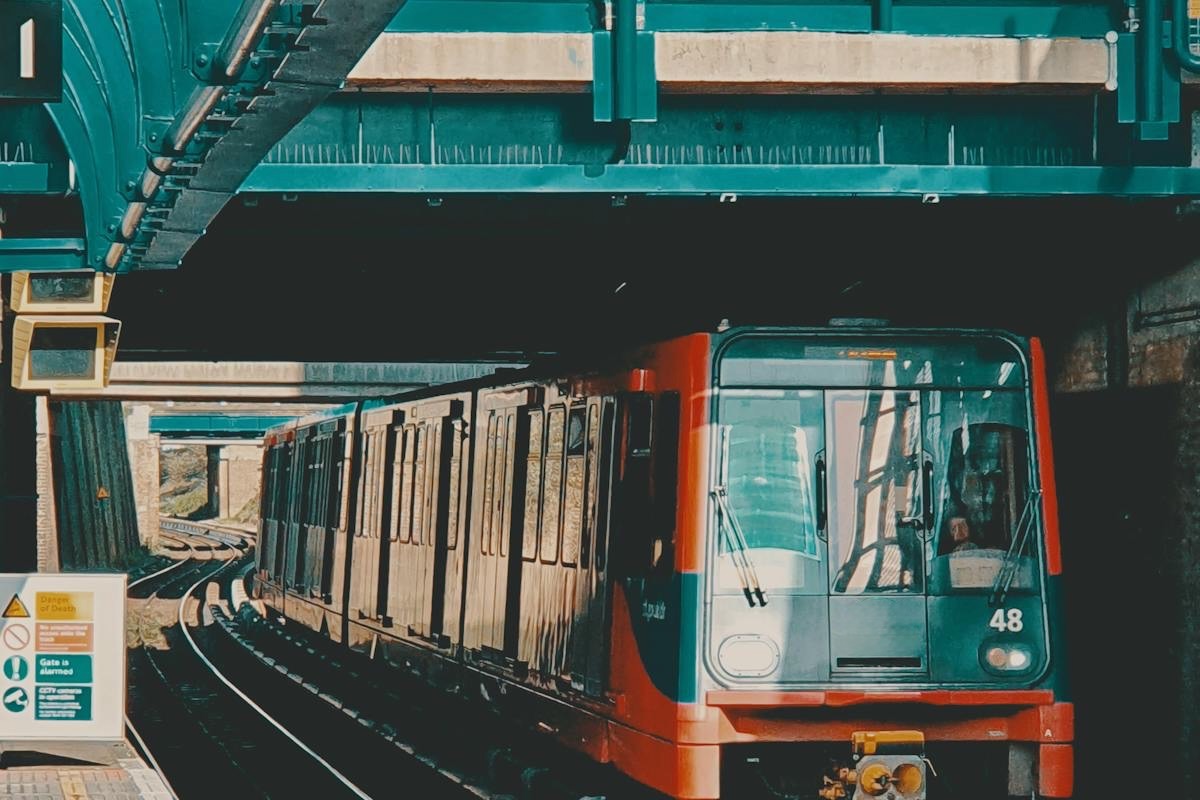
The DLR operates at GoA3: no driver, but on-board staff for safety and dispatch. Photo: Pexels.
The Tube has been "mostly driven by computers" for decades
A lot of Londoners are surprised to learn that the Tube has a long history of ATO. The Victoria line was designed around it.
TfL's own history page makes the same point: "at the touch of a button" the train would close doors and run automatically, guided by coded track signals.
This is why the "driverless" debate so often talks past itself. If you ride the Victoria, Jubilee, Northern, or Central lines, you are already on a railway where the automation does a big chunk of the actual driving in normal service. The hard part is not getting a computer to brake accurately. The hard part is safely removing the last human role, especially at the platform edge and in emergencies.
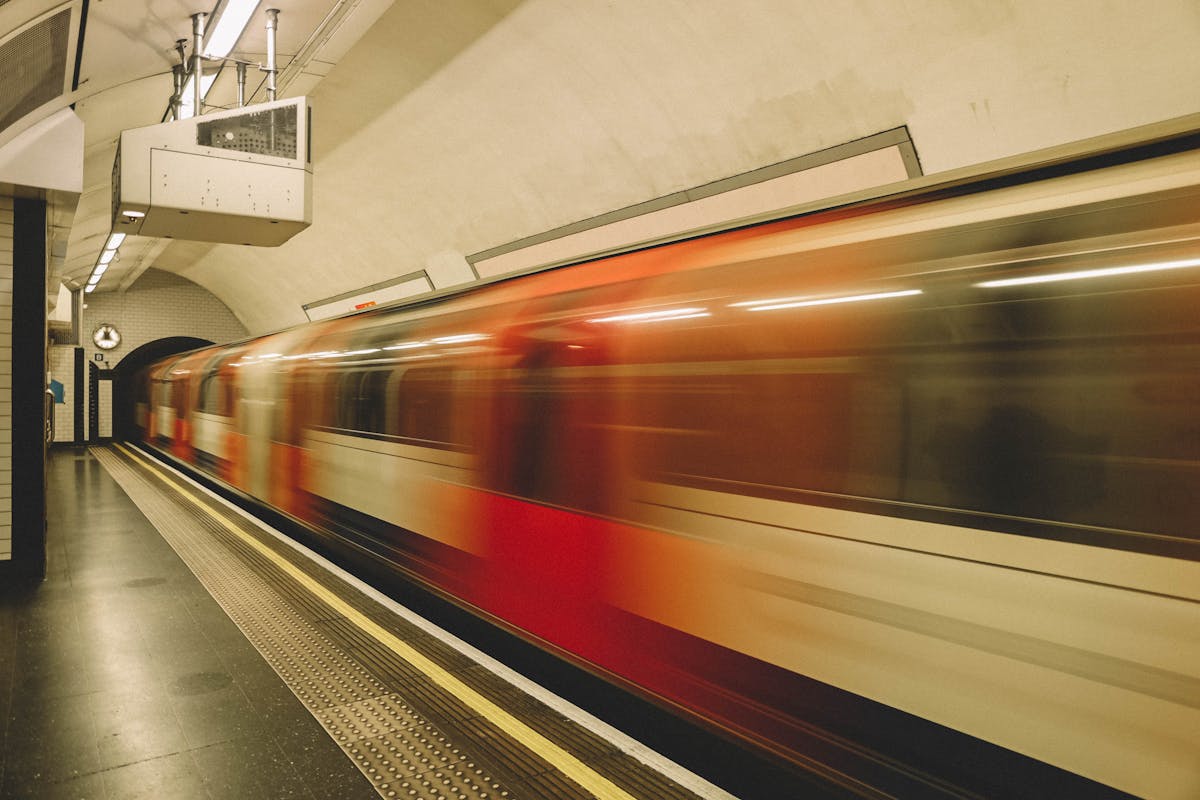
The Victoria line has used automatic train operation since its opening in 1968. Photo: Pexels.
The political moment that forced the question
The most concrete push towards driverless operation in recent years came from central government during TfL's pandemic-era funding crisis.
In the extraordinary funding settlement letter of 1 June 2021, the Department for Transport set out a "Driverless Trains" workstream and stated that it would lead a joint programme with TfL. The settlement required interim business cases for conversion work (including the Waterloo & City and Piccadilly lines), plus market engagement into alternatives to platform edge doors, and design work covering rolling stock, signalling, and platform edge doors.
A later TfL Finance Committee pack recorded those milestones as formal programme items (interim OBC and SOBC milestones, the platform edge protection market engagement, and associated design work).
This was not a vague "one day we might" exercise. It was a structured attempt to test whether the business case for GoA3 (and potentially further) could be made to work on real lines, tied to the capital realities of trains, signalling, and stations.
What that work concluded, officially
By late 2024, the public-facing conclusion hardened.
In a written answer published by the London Assembly, Sadiq Khan stated that the work concluded driverless conversion would "cost billions of pounds on each line" and that "the work shouldn't be progressed any further."
The key point is not just "it's hard". It is "it is hard enough, and expensive enough, that the cost-benefit case did not stack up".
TfL's operational position: no driverless Tube plan on the table
Even if you ignore the politics, the engineering roadmap still points to supervised automation as the near-term ceiling.
A 2024 TfL FOI response about the Piccadilly upgrade states plainly that new Piccadilly trains will be introduced to operate with the existing signalling system and that the signalling upgrade is not currently funded.
Another FOI response in 2025 reiterates that re-signalling the Piccadilly line is unfunded, and states TfL's goal is to achieve GoA2 through automatic train control, as already implemented on the Victoria, Central, Northern, and Jubilee lines, and being implemented on the sub-surface lines.
That is not the language of an organisation preparing for unattended GoA4 operation. It is the language of “more automation within a staffed, supervised model”. Our technical deep dive on how the Tube works covers how these signalling systems operate in practice.
The real blockers to "fully driverless" operation
This is the part that matters if you want to understand why the Tube is not simply following Copenhagen or Paris. The barriers fall into a handful of buckets, and they reinforce each other.
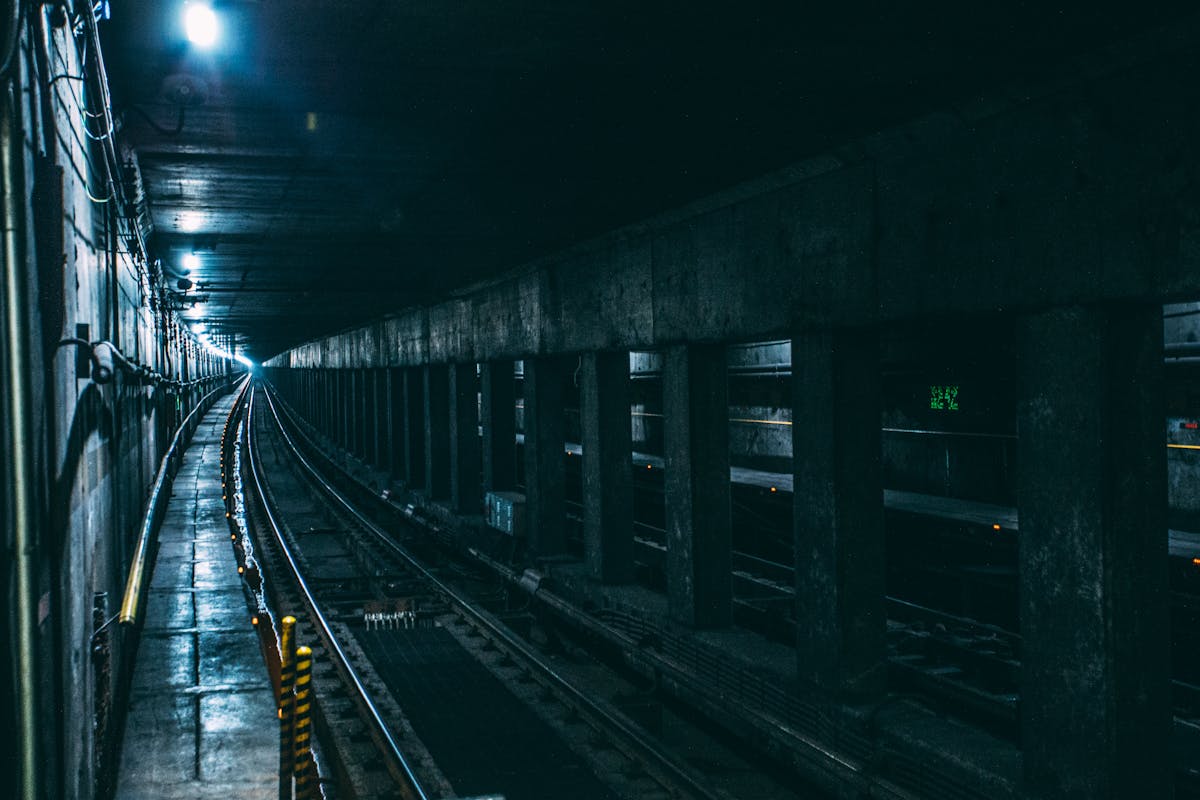
Victorian-era tunnel geometry creates unique engineering constraints for automation retrofits. Photo: Pexels.
1 The platform-train interface: the riskiest bit of the railway
The greatest safety headache is not keeping trains apart. It is managing what happens where passengers and moving trains meet. In procurement language, it is the "platform-train interface (PTI)".
Platform edge doors (PEDs) are the most obvious mitigation, but TfL went looking for alternatives precisely because PEDs are expensive and inflexible in some locations.
TfL also notes in an FOI response that it is generally inefficient to install PEDs at only one or two stations in isolation because of the complex integration between doors, trains, and signalling.
That, on its own, pushes you towards an "all platforms on a line" scope, which pushes you into "billions" territory.
2 PEDs are doable in London, but not cheap
London has successful examples: the Jubilee line extension has platform edge doors at the underground extension stations, and the Elizabeth line's central stations use full-height platform edge screens.
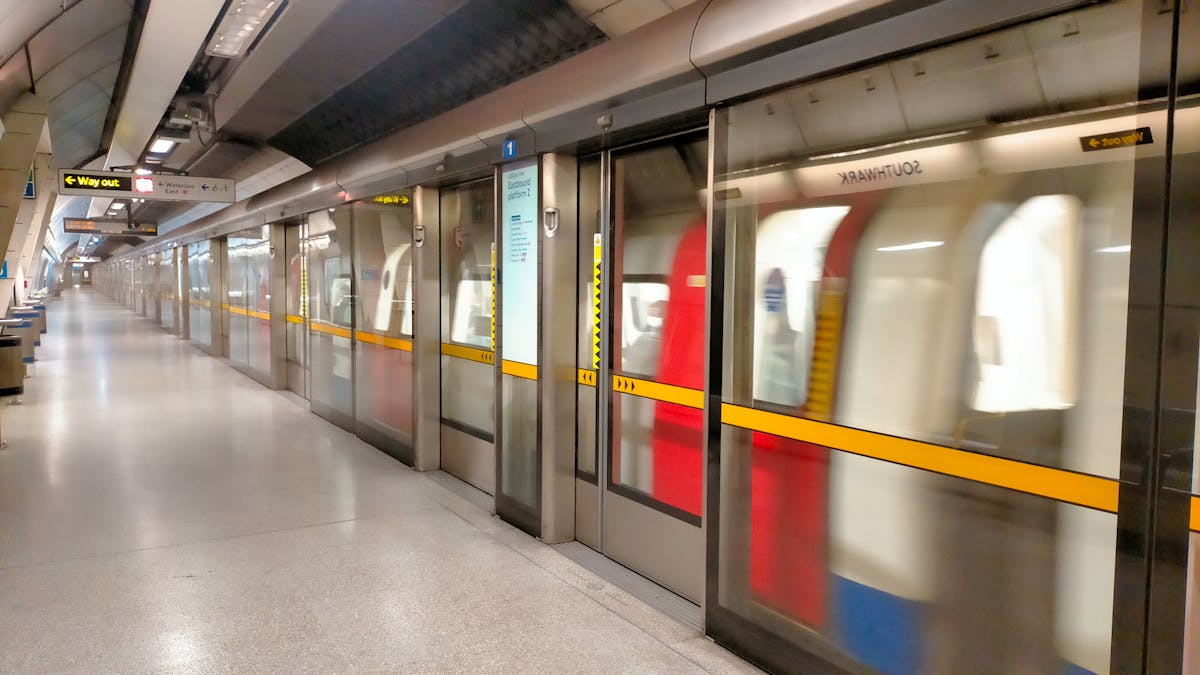
Platform edge doors at Southwark on the Jubilee line extension: proven technology, but expensive to retrofit network-wide. Photo: Pexels.
The cost problem is illustrated by TfL's own FOI disclosures. One response states the anticipated final cost for a platform edge doors contract was approximately £85m, giving a derived cost of about £21,300 per metre.
That figure should be treated carefully. It is not a universal "PED cost" for every station. But it makes the scale of the problem easier to grasp: if you need PEDs widely, you are quickly talking about very large numbers, before you even touch signalling, power, ventilation, or civil works.
3 "Mind the gap" is not a slogan, it is an engineering constraint
Older Tube stations have tight curves, varying platform heights, and awkward clearances. Doors need precise alignment, reliable stopping, and tolerance management over time as track geometry and wheel profiles wear.
Modern systems solve this through combinations of straight platforms and consistent train geometry (new-build advantage), platform reconstruction to standard offsets, and door systems designed as a matched set: train doors, platform doors, and the signalling that ensures they only open when correctly aligned.
This is one reason London's own official narrative leans towards bundling driverless aspirations with full line upgrades, not piecemeal changes.
4 Degraded mode operation: the stuff that ruins simplistic business cases
A "perfect day" railway is easy to automate. A "London day" railway is not.
Even on GoA2 lines, a driver is there to handle things like:
- Passenger illness and emergency alarms.
- Door obstructions and platform incidents.
- Track intrusion, smoke alerts, or equipment faults.
- Improvised service patterns during failures (terminations, reversals, wrong-road moves).
GoA3 can work here, but it shifts the role rather than removing it. That is exactly what the DLR model embodies: no driver in a cab, but an on-board member of staff for dispatch, safety, and degraded modes.
GoA4, unattended operation, raises the bar further. If nobody is on board, you need systems and staffing elsewhere to manage evacuation, passenger reassurance, and incident response, without delaying service recovery.
5 The network is operationally complex, not a sealed shuttle
The Tube is not one homogeneous system. It is a set of lines with branches and junctions, interworking constraints (especially on the sub-surface network), and depots, sidings, and engineering access requirements.
Automation can still work in complex networks, but it tends to be easier when the system has been designed around it from the start, or when the upgrade scope is deep enough to reshape the operational model, not just the signalling layer.
What London is investing in instead: more GoA2, more capacity
It is worth separating "driverless" from "automation that actually delivers benefits".
London's recent upgrade history shows a pattern: modern signalling plus ATO, with a driver still present, delivering capacity and reliability improvements. It is worth noting that automation improves consistency more than it improves raw speed - the gains are in tighter headways and smoother driving, not higher top speeds.
TfL has publicly credited the Victoria line running "up to 34 trains per hour" and the Jubilee line "up to 30 trains per hour" as outcomes of investment programmes that included signalling and rolling stock.
On the Northern line, a TfL board paper states the 2014 signalling upgrade enabled peak service increases through the central section and branches, with further capacity constrained by rolling stock and other infrastructure.
For the sub-surface railway, TfL board documentation describes Four Lines Modernisation as one of the largest and most ambitious signalling upgrades on the network, combining signalling, rolling stock, and other assets.
None of this is "fully driverless". But it is exactly the kind of automation that tends to pay back: higher frequency, tighter headways, smoother driving profiles, and more resilient service patterns.
Unions, staffing, and why "driverless" is politically explosive
If you want the full picture, you cannot ignore workforce politics. Driverless proposals hit at jobs, identity, and safety narratives.
ASLEF has long framed driverless proposals as unrealistic and politically motivated. In 2020 it described driverless trains on the Underground as a "politically-driven fantasy".
RMT, in a submission on driverless and unattended operation, argued that every train must have a driver for safe and effective operation and criticised automation proposals as staff-reduction exercises.
On the other side of the argument, central government voices have repeatedly pointed to the DLR as proof that London can do "driverless" and have implied that automation is part of making TfL financially sustainable.
This clash is one reason "driverless" tends to arrive as a headline, not as an engineering footnote. It is a proxy fight about funding, reform, and control, not just technology.
What enthusiasts, engineers, and forums argue about
A useful way to test the reality of the idea is to look at what informed hobbyists and industry-followers argue about when politics is stripped away. Several themes come up repeatedly:
This matches the GoA framing and the Victoria line's long-running ATO reality.
"If you want to remove staff, you need platform edge protection across most of a line." That aligns with TfL's own PTI risk language and its comments about the inefficiency of isolated PED installs.
"The economics are not as obvious as people assume." Commentators arguing against the business case often point out that automation can shift costs rather than remove them (more station staff, more control room capability, more maintenance, more complex safety assurance).
"Waterloo & City looks simple on a map, but the safety case is the killer." This is a recurring idea because the line is self-contained. The counterargument is that evacuation and incident handling in deep tunnels without on-board staff is exactly where the risk concentrates.
Forums are not primary evidence, but they are good at surfacing the practical questions politicians avoid. When those questions line up with TfL and DfT documentation, they are worth taking seriously.
International comparisons, and why they only go so far
It is true that fully automated metros exist and work well. But the context usually differs in ways that matter.
Paris
Line 1 was converted while in service; Line 14 was built for automation. Platform screen doors and a dedicated conversion programme were critical enablers.
Copenhagen
A textbook purpose-built, fully automated system. Consistent platform environments, modern stations, and an operating model designed for unattended operation from the outset.
Singapore
Long-running automated metro lines with strong platform-edge mitigations and stringent operating discipline, within a system designed with automation in mind.
Dubai
A comparatively modern system, built for driverless operation from scratch — not retrofitted into Victorian-era geometry.
London's own official answer explicitly notes that the driverless feasibility work drew "learning from other metros around the world, particularly Paris". The conclusion was not "we cannot do it". It was "we can, but not at a price that makes sense for London right now".
So, when will the Tube be fully automated?
If you mean GoA4 unattended operation across the network, the evidence currently points to "not in any defined timeframe". The most recent official conclusion was that pursuing it would cost billions per line, and the work was stopped.
If you mean "more automation" in the practical sense, that is already happening and will continue: GoA2-style ATO is already standard on several lines and is being extended through major signalling programmes (including on the sub-surface railway). The strategic direction in TfL documents and FOI responses points to more GoA2, not a near-term push for GoA3 or GoA4 on the Underground.
If you mean GoA3 on one line (DLR-style driverless, with an attendant), that is the most technically plausible "next step" on paper. It was explicitly within the scope of the government-led workstream. But the same official conclusion about costs still applies, because GoA3 at Underground scale still drags in platform edge risk, signalling, rolling stock, and station geometry.
A more honest way to frame it
The Tube is not waiting for driverless technology. It is negotiating the cost of making hundreds of platforms, dozens of depots, and a century-old civil engineering environment safe and reliable enough that you can remove the last on-board human role.
That is why the debate keeps collapsing back into the same trio of requirements: new trains, new signalling, and platform edge protection. When you see those three named together, you are seeing the real price tag of "driverless".
- GoA2 continues: London will keep automating the driving because it increases capacity and consistency.
- GoA4 is off the table: A fully unattended Tube is not on an agreed roadmap, and recent official work said the economics do not justify it.
- GoA3 is the only plausible next step: "Driverless" in the DLR sense is the only version that looks remotely achievable on Underground lines, and even that has been judged too expensive to pursue right now.
We're a small team based in Hackney, East London, building highly customisable tube alerts. Choose your lines, set your time window, pick your days, and filter by severity — we'll only email you when something actually affects your commute.
Set up a free alert →
Why Is It So Hot on the Tube?
TfL temperature data, the physics of tunnel heat, and what is actually being done about it.
How Fast Does the Tube Actually Go?
Speed by line, braking physics, station spacing models, and global metro comparisons.
Is the Tube 24 Hours? Night Tube Guide
Which lines run all night, when they operate, and your alternatives when the Tube shuts.
This article is regularly updated as new information becomes available. Send us a tip if you spot something we should include.