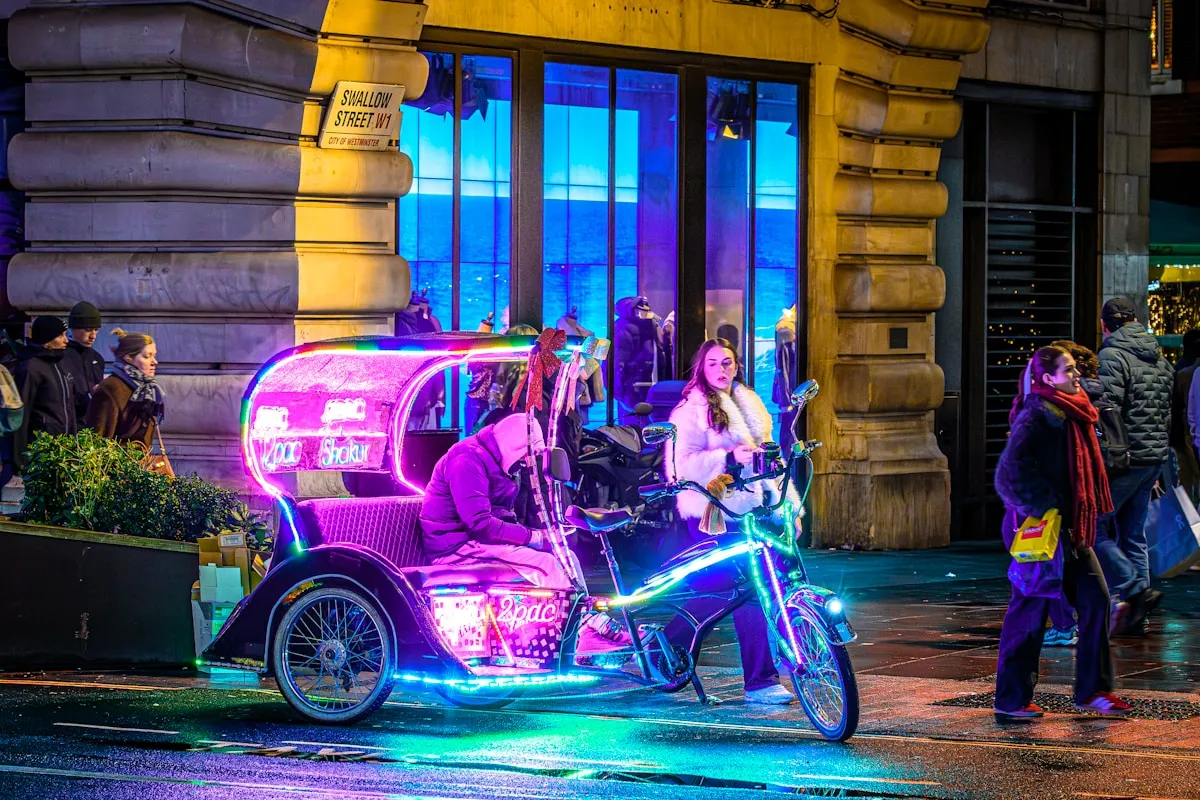
I have a pet theory that London is brilliant at inventing problems, then slowly, expensively, and publicly learning how to un-invent them.
Pedicabs (or rickshaws, depending on how annoyed you are at the time) are a perfect example. They look harmless. They are technically human-powered (often not entirely). They trade on a tourist-friendly vibe. And yet, for years, they have operated in the sweet spot of being loud enough to be everyone's problem, and legally slippery enough to be nobody's responsibility.
That changed this week: TfL has finally started introducing London-wide pedicab regulations, enforced in stages over the next year.
Good. Now for the awkward part: I do not think London should feel proud that it took this long.
The most honest summary of the pedicab era
Pedicabs became a fixture in the West End without the basics we expect from anything that carries passengers for money: consistent safety standards, meaningful vetting, transparent pricing, and enforceable behaviour rules.
TfL's own consultation write-up is unusually blunt about what Londoners said last time around. Many respondents wanted pedicabs banned outright, described the audio as "too loud and anti-social", and raised safety concerns. TfL also explicitly notes that the law gives it power to regulate, not ban.
That "not ban" detail matters, because it frames what success looks like. We are not heading for a pedicab-free West End. We are heading (hopefully) for a version of this industry that cannot freeload on chaos.
The numbers that make me sceptical of the "harmless fun" argument
Here are the bits of evidence I keep coming back to.
1 Noise is not a minor gripe. It is the main event.
TfL says that more than 2,400 respondents commented on pedicab noise, and 96% supported stronger controls on music and other audio emitted from pedicabs.
When you get 96% agreement on anything in London, you are not dealing with a niche complaint. You are dealing with a public space problem.
TfL's answer is a simple one: prohibit externally amplified audio. I will be honest, I will believe it when I can walk past Leicester Square at night and still hear my own thoughts.
96% of 2,400+ consultation respondents supported stronger noise controls on pedicabs. That level of agreement is almost unheard-of in London transport consultations.
2 "Rip-off fares" are not a rumour. They are central to why this is happening.
TfL's press release explicitly references "well-documented rip-off fares", and the new framework includes maximum journey fares for the first time.
Media reporting has repeatedly described extreme examples (the kind that make you double-take even if you already assume the worst), including stories of tourists allegedly being billed hundreds of pounds for minutes of travel.
You can argue about edge cases, but the policy response tells you what TfL thinks the distribution looks like. You do not build a London-wide fare cap because a couple of people felt mildly overcharged.
3 Safety and crime risk is real enough to show up in incident reports.
An industry can be annoying and safe, or quiet and risky, but pedicabs have spent too long flirting with both. A licensing sector update published in late 2025 reported 24 pedicab-related incidents (2018-2023), including six sexual offences and 13 injury-causing collisions.
That is not a definitive safety rate (we do not have reliable exposure data, like total journeys), but it is still an uncomfortable signal for something that has operated with minimal oversight.
4 Scale is not trivial. This is not five novelty bikes.
During peak season, reporting has put the number of operating pedicabs in central London at around 900.
Even if that figure is imprecise, it aligns with what anyone who has walked through the West End on a busy night can see: this is not a quirky sideshow. It is a transport mode in all but name, occupying road space, kerb space, and pedestrian patience.
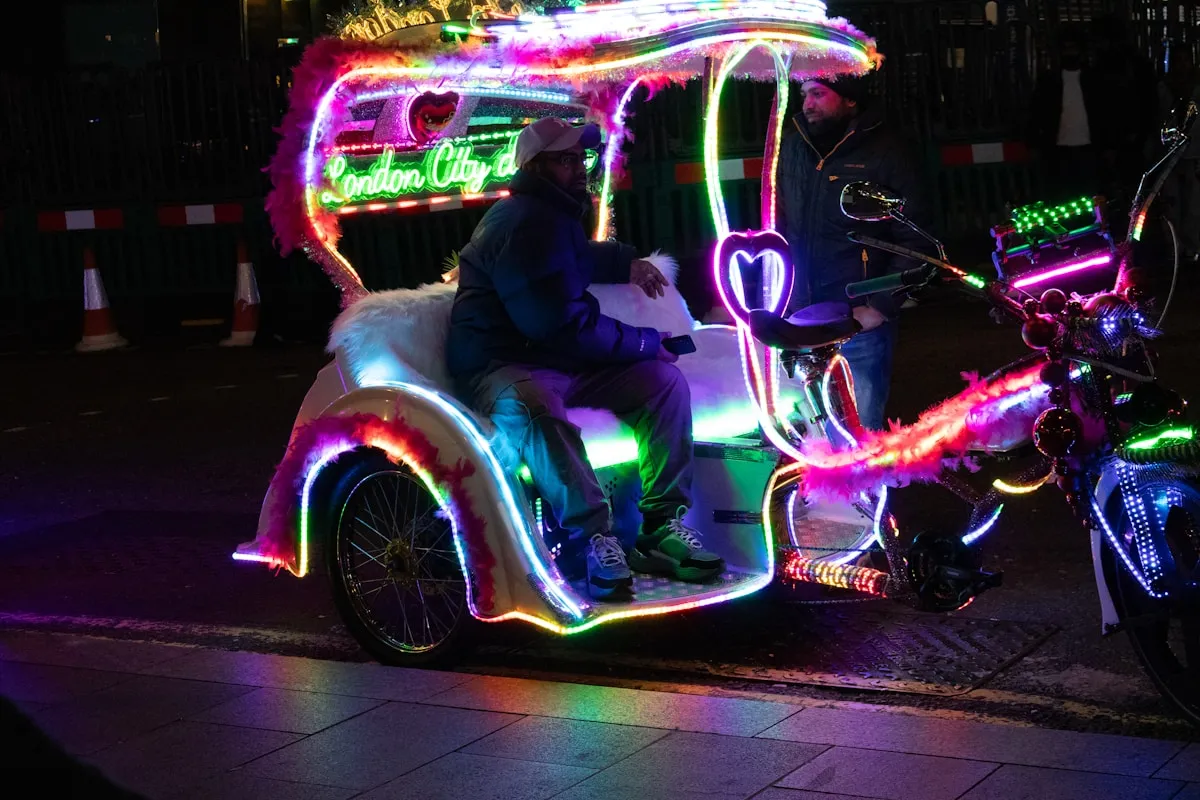
Around 900 pedicabs operate in central London at peak season - enough to make the West End feel like a different transport system entirely. Photo by Tanya Barrow on Unsplash.
What TfL is actually doing (and when)
TfL's roll-out matters because it tells you how quickly the street experience will change.
Core standards (starting now, enforced in stages)
TfL says the regulations introduce minimum standards for drivers, vehicles, and operators, including:
Drivers: enhanced DBS, medical standards, driving licence or theory test certificate, English language requirements, and assessments.
Vehicles: road-legal requirements, regular safety checks, visible identifiers, and the ban on external audio.
Operators: requirements such as a London premises, record keeping, and basic checks for staff.
The bit most people will care about first: fare caps
TfL's planned maximum fares (subject to approval) are set out as:
| Component | Proposed cap |
|---|---|
| Base fare | up to £5 |
| Per-minute charge | up to £1 per minute |
| Extra passenger | up to £3 per additional passenger |
So a 10-minute ride would cap at £15 for one passenger (£5 + £10), and £18 for two (£5 + £10 + £3). Not cheap, but it is at least legible. For comparison, a single Tube fare across central London is under £3.
TfL says fares were set so drivers can still earn an income above the London Living Wage, and that they will be kept under review.
Fees and dates (this is where my patience starts to fray)
| Milestone | Date |
|---|---|
| Annual driver licence fee | £114 |
| Annual vehicle licence fee | £100 |
| Applications open | 9 March 2026 |
| Driver & operator licences mandatory | 30 October 2026 |
| Fare caps come into force | 30 October 2026 |
| Vehicle licences mandatory | February 2027 |
I understand transitional periods. I also understand what a long runway does in practice: it creates a year where bad actors have every incentive to cash in before the shutters come down.
March 2026
Applications open. The licensing framework exists on paper but is not yet enforceable.
9 March 2026October 2026
Drivers must be licensed. Fare caps enforced. The first real test of whether this changes the street.
30 October 2026My worry: regulation exists, but enforcement is where London usually blinks
London already has experience here. Westminster introduced a Public Spaces Protection Order (PSPO) in late 2025 aimed at issues like loud music, speeding, obstruction, and intimidating behaviour, with £100 fines.
That is not nothing, but it is also not the same as making an entire sector behave. A £100 fine is a deterrent only if you get one, and only if you care.
This is why I am watching two things more than any press release:
On-street compliance activity (checks, seizures, penalties that actually land). TfL says its compliance team will do on-street checks.
Pricing transparency before a ride begins.
On the second point, the London Assembly Transport Committee explicitly said that to guarantee fairness and avoid exploitation, TfL should require fares to be displayed clearly before the journey starts.
What I want TfL to do next (because this cannot be another slow London compromise)
TfL now has wide powers on fares, standards, and restrictions under the Pedicabs (London) Act framework. So here is my wish list, in plain English:
- Make price visibility non-negotiable: a clear fare card, visible from outside the vehicle, plus a timed meter display during the ride (or an equivalent).
- Create designated ranks, and enforce them (especially around theatres, stations, and the obvious hotspots). Stations like Oxford Circus and Leicester Square already close occasionally due to overcrowding - pedicab congestion outside them does not help.
- Treat persistent noise breaches like a licence issue, not just a fine issue. Ban means ban.
- Publish enforcement stats monthly, at least for the first year: checks carried out, licences issued, fixed penalties, seizures, prosecutions. If it is working, show London.
- Move faster where TfL can. The October 2026 and February 2027 milestones feel late for a problem that has been festering for a decade.
How this fits into the wider London transport picture
Pedicabs occupy a strange gap. They are not part of TfL's network, but they rely on it - positioning themselves outside Tube stations, along bus routes, and in the pedestrian zones where the Piccadilly and Northern lines bring millions of people to the surface.
When a major line is disrupted - check the live status page on any Friday evening - the West End gets busier, pavements get more crowded, and pedicabs thrive on the confusion. That is not illegal, but it is the kind of dynamic that regulations should anticipate.
The same stations where pedicabs cluster are often the ones that experience temporary closures due to overcrowding. Oxford Circus, Leicester Square, and Piccadilly Circus have all been closed to entering passengers during peak periods. Adding unregulated road-level congestion to an already strained interchange does not help anyone.
If you commute through the West End, the quality of the street-level environment directly affects your journey - from the moment you leave the station to the moment you reach your destination. Pedicab regulation is not a niche licensing issue. It is a last-mile transport issue.
Bottom line
- Long overdue: Pedicabs have survived in London not because they were a great idea, but because no one had the right lever to pull, consistently, across the whole city.
- The lever now exists: TfL pulling it this week is a win for residents, visitors, and anyone who has ever tried to cross a West End junction while being sonically assaulted by a fluorescent carriage.
- Enforcement is everything: TfL needs to do the most unglamorous part properly - enforce it, publish the results, and stop pretending that "a bit of fun" is an acceptable excuse for an industry that has relied on noise, confusion, and intimidation.
- The real test: Quieter streets, transparent fares, and a sector that behaves like every other passenger-carrying service in London. That would be the real success.
If this ends with quieter streets, transparent fares, and a sector that behaves like every other passenger-carrying service in London, I will gladly stop talking about pedicabs forever.
That would be the real success.
We're a small team based in Hackney, East London, building highly customisable tube alerts. Choose your lines, set your time window, pick your days, and filter by severity. We will only email you when something actually affects your commute.
Set up a free alert →
Are Lime Bikes Worth It in London?
Pricing, passes, borough politics, and how dockless bikes fit alongside the Tube and Overground.
Tube Fares in 2026: What You Actually Pay
PAYG singles, daily and weekly caps, Oyster vs contactless, and the tapping mistakes that cost you money.
How to Use the London Underground
The complete 2026 guide: contactless payments, fares, Night Tube, accessibility, and airport connections.
This article is regularly updated as new information becomes available. Send us a tip if you spot something we should include.